
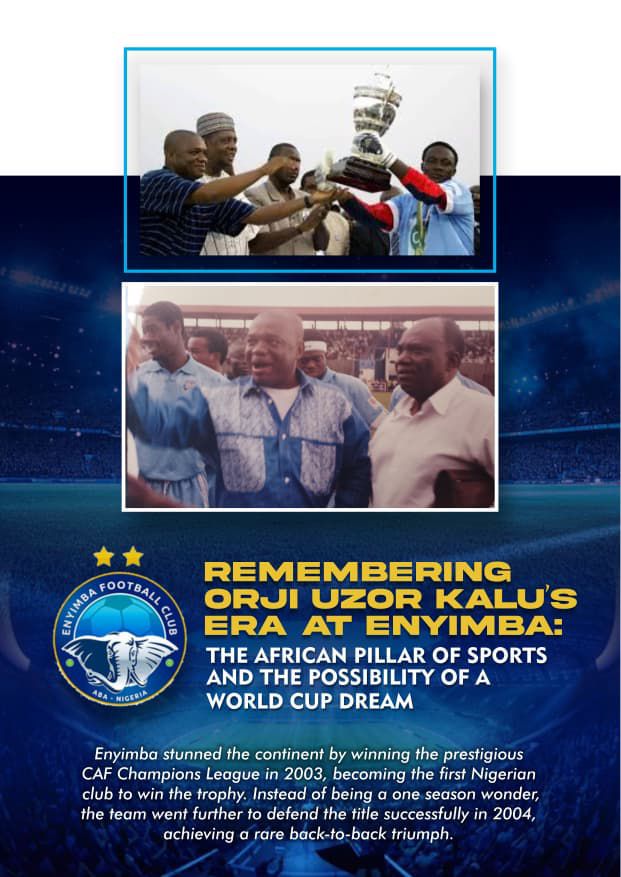
In Nigerian football history, the transformation of Enyimba FC in the early 2000s remains one of the greatest success stories in African club football. At the center of that historic rise was Orji Uzor Kalu, whose leadership and passion for sports earned him the respected title “The African Pillar of Sports.”
His era at Enyimba did not just produce trophies, it created a model of how visionary leadership can transform sports institutions and inspire national pride.
Before the early 2000s, Nigerian football clubs struggled to make a lasting impact in continental competitions. While Nigeria had immense football talent, poor organization, limited funding, and weak management often hindered success at the highest level.
That narrative changed dramatically during the administration of Orji Uzor Kalu as Governor of Abia State. Recognizing the unifying power of football, he invested heavily in the development of Enyimba and built a professional structure around the club.
Enyimba stunned the continent by winning the prestigious CAF Champions League in 2003, becoming the first Nigerian club to win the trophy. Instead of being a one season wonder, the team went further to defend the title successfully in 2004, achieving a rare back-to-back triumph.
These victories elevated Enyimba from a local Nigerian club into a continental powerhouse and placed Nigeria firmly on the African football map.
The success of Enyimba under Kalu was not accidental. It was the product of deliberate leadership decisions and strategic investment in sports development.
Orji Uzor Kalu’s administration ensured the improvement of the Enyimba International Stadium in Aba and created a fortress for the team and an electrifying atmosphere for supporters.
The players received better welfare, bonuses, and motivation, which boosted morale and performance.
The club adopted a more organized administrative structure, ensuring discipline, focus, and professionalism.
Young talents were identified and nurtured, ensuring a steady pipeline of players for the club.
Through these measures, Enyimba developed a winning mentality that allowed them to compete with and defeated Africa’s biggest clubs.
The success of Enyimba during this era went beyond trophies. It restored confidence in Nigerian club football and inspired other teams to aim higher.
For many football fans, the Enyimba triumphs symbolized what Nigeria could achieve when leadership, vision, and organization come together.
It also demonstrated an important truth, showing that sports success is often a reflection of leadership outside the pitch.
When administrators provide the right environment, players can perform at their best.
Nigeria has long been one of Africa’s strongest football nations. The Nigeria national football team has produced legendary players and regularly participates in the FIFA World Cup.
However, the country has yet to reach the ultimate milestone of winning the World Cup.
Many observers believe that achieving such greatness requires not only talented players but also visionary leadership capable of building strong sports systems, infrastructure, and youth development programs.
Supporters of Orji Uzor Kalu often point to his achievements with Enyimba as evidence of his ability to turn ambition into reality.
If the same strategic thinking, discipline, and investment that produced African champions at Enyimba were applied on a national scale, Nigeria could potentially build a football system capable of competing with the very best in the world.
The nickname “African Pillar of Sports” did not emerge by accident. It was earned through tangible results that transformed Nigerian football history.
Orji Uzor Kalu’s era at Enyimba proved that leadership in sports can inspire millions, unite communities, and elevate a nation’s image on the global stage.
His legacy in sports continues to remind Nigerians that greatness is achievable when vision is matched with action.
From lifting the CAF Champions League to inspiring dreams of global football glory, that golden era remains a proud chapter in Nigerian sports history.
