
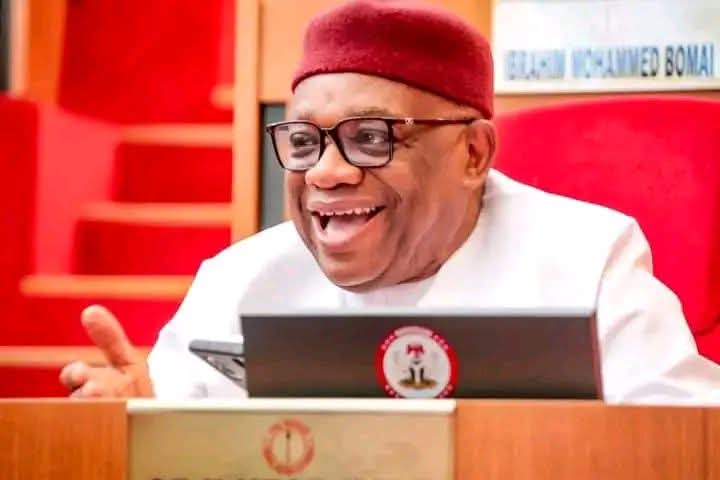
A growing body of data and development indicators suggests that Senator Orji Uzor Kalu’s representation of Abia North Senatorial District has yielded measurable economic improvements, with analysts pointing to targeted investments in infrastructure, agriculture, and education as key drivers of growth.
Speaking to journalists in Umuahia, on Friday, 27th February, renowned development analyst Professor Anya Ndukwe showed that the foundation for Abia North’s current economic trajectory was laid during Kalu’s tenure as Abia State governor (1999–2007) and has been sustained through his legislative interventions since 2019.
According to National Bureau of Statistics reports from Kalu’s gubernatorial era, Abia State recorded a poverty rate of 40.9 percent the lowest in the entire South-East geopolitical zone and among the top five lowest nationally . Professor Nduwke attributes this performance to what he describes as “deliberate, long-term efforts to structurally reduce poverty” rather than temporary handouts.
”The people of Abia North now have better access to education, roads, income, and jobs than many other areas in the zone. That is the Kalu effect,” Ndukwe stated.
The most significant economic intervention under Kalu’s current senatorial mandate is the ongoing construction of a world-class cashew processing factory and tricycle assembling industries in Igbere, Bende Local Government Area.
The facility, which features installed cutting and shelling lines, ovens for roasting, humidifiers, and peeling and baking equipment, is designed to directly employ over 5,000 youths . Strategically located within Abia’s cashew belt spanning Isuikwuato and Umunneochi LGAs, the factory will process raw cashew nuts that were previously exported with minimal value addition.
Industry analysts project that increased cashew processing could generate significant revenue for Nigeria, with estimates suggesting the sector could contribute as much as $3.7 billion to the national economy through exports and value-added products.
The factory’s multiplier effect extends beyond direct employment, expected to stimulate economic activities across farming, supply, packaging, and distribution chains while positioning Abia North as an emerging agro-business hub.
Recently, Kalu and Chinese billionaire, Zhu Gongstan, CEO of GCL group signed a multimillion dollar deal which will likely be domiciled somewhere in Abia North creating over 3,000 direct jobs and 4,000 indirect jobs while closing the gap of renewable energy and lithium battery conservation. Kalu also took Zhu to top government officials and captains of industries like Wale Edun, Hon Minister of Finance, the coordinating minister of the economy and Aliko Dangote President of the Dangote Group respectively, thereby increasing Nigeria’s Foreign Direct Investments, FDI.
Data obtained from the senator’s constituency office indicates that over the past six years, Kalu has facilitated the construction of more than 160 rural roads connecting remote farming communities to commercial centers.
Opening up farming communities like Ndi Orieke–Ohafia Road, Amankalu–Abiriba Road, easing transportation across Bende LGA, Akoli Imenyi Road, in Bende LGA. FG intervention in Umunneochi LGA, like the Lokpaukwu-Lokpanta Road and various roads across Arochukwu, Ohafia, Isuikwuato, and Umunneochi LGAs that are currently under reconstruction.
These infrastructure investments have reportedly reduced post-harvest losses and increased farmers’ incomes by providing reliable access to markets.
Continuing his governorship-era free education legacy, Kalu has overseen the construction of over 140 new schools and renovation of more than 100 others across the senatorial district . His office has distributed free educational materials including school bags, uniforms, and books to students.
Kalu has facilitated the construction of over 120 classroom blocks, with particular emphasis on Science, Technology, Engineering, and Mathematics (STEM) subjects through textbook provisions . Additionally, more than 50 under graduate students and 3 post graduate students from the district are currently studying Medicine and Surgery, Chemistry and Business Administration abroad through supported programs.
Data from empowerment programs shows Kalu has distributed thousands of productive assets to constituents, including; Sewing machines, refrigerators, and generators to small business operators. Over 1000 cassava processing machines to farmers across the 103 wards of the senatorial district. Motorcycles for transportation businesses. Financial grants for enterprise development. High-quality fertilizers, rice seedlings, and farm inputs to agricultural workers.
The cassava processing machines distribution, which took place across the district, was particularly hailed by women farmers who described it as “coming at the right time” to reduce processing costs and increase output.
In a startling revelation, Prof. Nduwke disclosed that Kalu has facilitated approximately $500 million in foreign direct investment into Abia North. Beyond the cashew processing plant, this investment portfolio includes, a solar light manufacturing factory the first of its kind in Abia State, a tricycle assembly plant, expansive cassava, cocoa, and other agricultural farms across communities in the district.
Kalu’s economic influence extends beyond his immediate constituency. As Chairman of the Senate Committee on the South East Development Commission (SEDC), he recently led efforts to secure a N140 billion budget for the commission, augmented by an additional N25 billion proposed for impactful development projects across the five South East states.
The Commission received minimal funding in 2025, forcing suspension of numerous projects. The augmented 2026 budget aims to “reactivate stalled projects and restore developmental momentum across the region,” particularly in the health and education sectors.
A reflective analysis by Prof. Nduwke stressed that Kalu governed Abia State during his gubernatorial years with significantly fewer resources than contemporary administrators receive which is four (4) times bigger in today’s economy, yet delivered “visible, functional, and lived” achievements.
The analysis concluded that “OUK built aggressively when money was scarce and systems were weak. Today’s government operates with more money, better systems, and fewer excuses”. Prof. Nduwke noted.
Community Leaders across the five local government areas comprising Abia North Bende, Ohafia, Arochukwu, Isuikwuato, and Umunneochi have expressed satisfaction with Kalu’s representation.
Mrs. Ngozi Ojukwu, Chairlady of Isiaku Alayi Women Development Association, was quoted as saying: “Our Senator has always priotized our needs. During the rainy seasons our roads used to be impassable but now he has constructed it… we now traverse smoothly without stress”.
The Coalition of South East Youth Leaders (COSEYL) has also officially endorsed Kalu’s anticipated re-election bid, describing his “grassroots impact” and “developmental strides” as unrivaled in the zone.
Data also shows that while Kalu is doing very well in facilitation of life changing projects in Abia North, he is also doing an amazing job in his core mandate as a legislator which is law making, oversight function and appropriations, having sponsored and co-sponsored over 80 bills in 6 years of his quality representation in the Red Chamber.
Senator Orji Uzor Kalu’s Strategic Transformation Responsible for Abia North Economic Growth – Prof. Anya Ndukwe
Share This
Previous Article
Abia Women Assembly President, Iyom Nnenna Obewu, Condemns Protest Against Sen. Orji Kalu, Calls for Responsible Politics
No Newer Articles
